
Echandia: Building Batteries for the Realities of the Sea


Published
Categories
Contributors
The maritime industry is quietly entering a highly consequential technology transition. Roughly 80 – 90% of global goods move by sea, carried by a fleet of just over 100,000 vessels. That relatively small fleet accounts for about 3% of global greenhouse gas emissions, with carbon intensity far higher than most other transport sectors.
This combination of scale, concentration, and regulatory pressure is pushing maritime toward a transition point. While the International Maritime Organization (IMO) recently postponed the vote on its global Net-Zero Framework until October 2026, local and regional momentum is moving forward unabated. In Europe, the FuelEU Maritime standards and the phase-in of the EU Emissions Trading System (ETS) are already forcing operators to account for their carbon footprint. This “bottom-up” regulatory environment means that, regardless of global delays, shipowners must act now to avoid becoming uncompetitive in major trade corridors.
Electrification is emerging as one of the most immediate and practical tools available. For many vessel types, especially those operating on fixed routes or returning frequently to port, batteries can now deliver lower lifetime costs, higher reliability, and meaningful emissions reductions at the same time.
Solving the Durability Gap in Maritime Electrification
S2G portfolio company Echandia has emerged as a critical player by addressing a core challenge that has slowed maritime electrification: durability. Ships operate for decades. They endure constant vibration, heavy mechanical loads, limited space, and harsh environmental conditions. Battery system failures can take a vessel out of service, disrupt port operations, and ripple across tightly scheduled supply chains.
Echandia’s approach is rooted in those realities. Its Lithium Titanate Oxide (LTO) battery systems are purpose-built for heavy-duty maritime use and prioritize operational longevity and safety. The result is a system guaranteed for 20,000 to 30,000 cycles, allowing many vessels to operate for 15 to 20 years without a battery replacement. Critically, Echandia is often the only supplier in the market willing to contractually guarantee this lifespan, turning durability from a technical spec into a powerful procurement advantage.
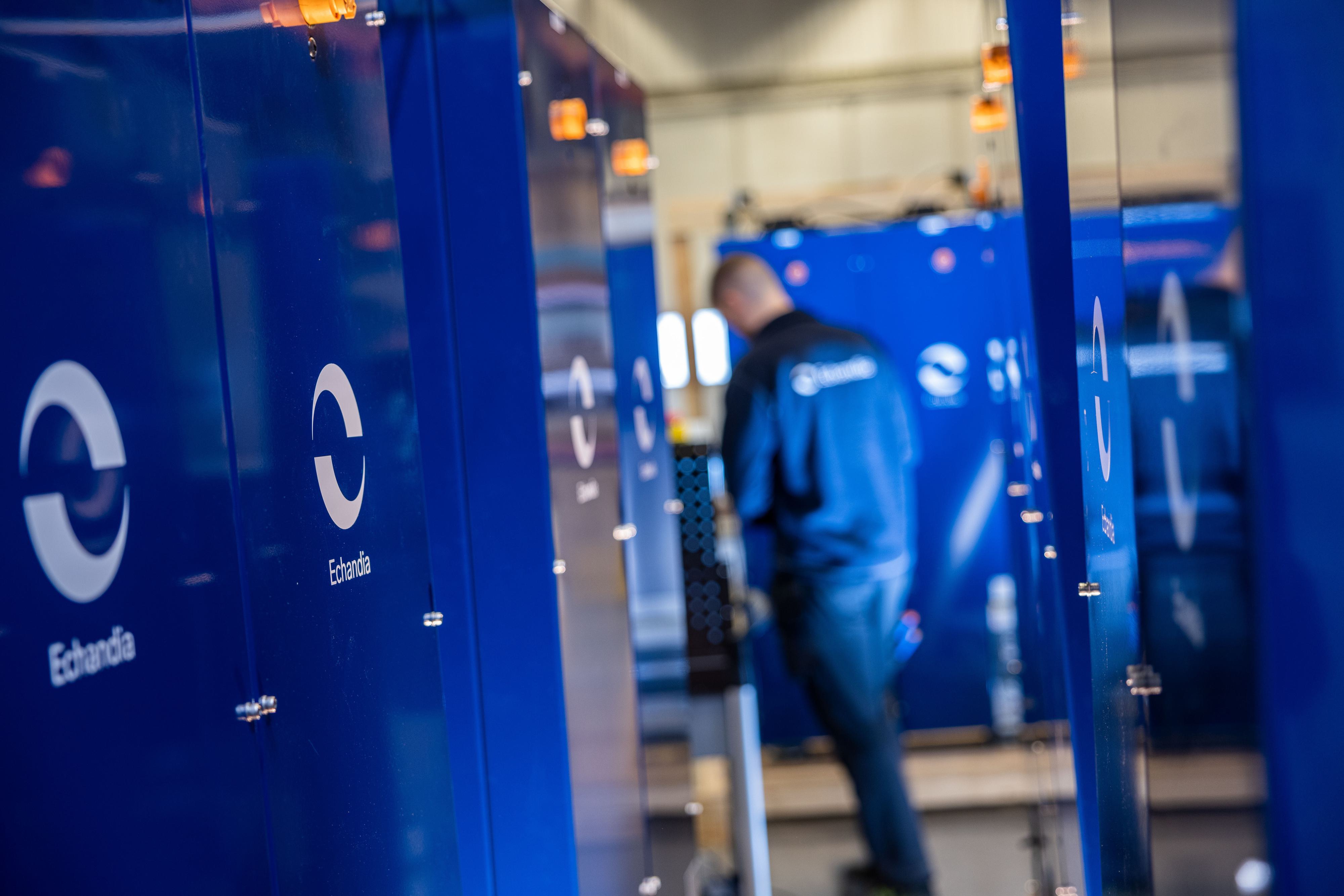
Unlike standard lithium-ion batteries, which use graphite parts that can overheat and catch fire under heavy use, LTO systems are inherently more stable and make the batteries virtually fireproof. This is a massive safety advantage, as a battery fire is the last thing any crew wants to deal with while at sea.
Echandia specializes in the most demanding maritime segments, including tugboats, ferries, RoPax vessels, and coastal workboats. These vessels operate on tight schedules with little tolerance for downtime, requiring high reliability, rapid charging, and predictable performance under continuous use.
Total Cost of Ownership Enables Climate Action at Scale
For shipowners, climate goals alone rarely justify capital decisions. Total cost of ownership does.
Replacing a maritime battery system can require dry docking, recertification, and weeks out of service. It creates a large future capital expense that sits on the balance sheet and introduces operational risk. Echandia removes that risk by aligning battery life with vessel life, effectively eliminating a major future capital event.
While cost per kilowatt-hour is often used to compare battery systems, it is a poor proxy for real-world performance. In practice, shipowners care far more about cost per delivered cycle of energy, downtime risk, and long-term operating expenses. Echandia’s systems are built to deliver predictable performance over thousands of cycles, which reshapes the economics over the full life of the vessel.
Operating economics improve further through performance. Echandia’s LTO systems recharge rapidly without degradation, and on some ferry routes, charging can be completed faster than passengers can board, enabling high-frequency service without extending port dwell times.
Lower emissions coincide with lower fuel exposure, reduced maintenance, and higher asset utilization.
Proof at Scale Across Global Fleets
Echandia’s recent project wins reflect where electrification delivers both climate and operational value.
In the U.S., Echandia is anchoring the nation’s first high-speed zero-emission ferry network through San Francisco Bay Ferry’s Rapid Electric Emission Free (REEF) program. These vessels will be powered by American-made batteries produced at Echandia’s new facility in Marysville, Washington, ensuring compliance with Buy America provisions and proving the scalability of zero-emission transit in major U.S. hubs.
In India, Echandia will supply the battery system for the country’s first fully electric tugboat at Kandla Port under the Green Tug Transition Program. The 4.4 MWh system was selected via a competitive tender where Echandia was the only provider able to guarantee 30,000 cycles over 15 years. This vessel is the vanguard of a program aiming to deploy up to 400 electric tugs by 2040, a massive infrastructure opportunity.

In Denmark, Echandia was selected in late 2025 to replace the original battery system aboard E/F Ellen, the world’s first long-range electric ferry. The upgrade replaces a 4.3 MWh NMC system with a more efficient 3.2 MWh Echandia LTO system, proving that Echandia’s tech can do more work with less physical mass while extending zero-emission operations well into the vessel’s future.
The company has also expanded into extreme environments. Echandia was recently awarded the contract via ABB to supply battery systems for a new hybrid icebreaker for the Canadian Coast Guard, and for newbuild cargo vessels for Spliethoff Group, where batteries reduce fuel use and mechanical wear during cargo operations. Furthermore, Echandia’s growing footprint in the naval defense sector demonstrates that their safety and stability standards meet the rigorous requirements of modern frigates.
Across more than 100 vessels delivered or on order, Echandia’s systems are already displacing diesel consumption in daily operations.
Why S2G Invested
In July 2025, S2G Investments joined Echandia’s most recent funding round, bringing total capital raised to approximately $36 million.* Over the past year, S2G has worked closely with Echandia to accelerate their U.S. market entry and scale production at their Washington State facility to meet the rigorous demands of domestic transit agencies.
At S2G, we view maritime electrification as one of the most immediate and scalable pathways to improve the performance of a critical global industry. Electrifying vessels reduces emissions, but it also improves fuel cost predictability, lowers maintenance burdens, strengthens compliance readiness, and increases operational resilience across supply chains that underpin global trade.
Looking ahead, we believe the technologies that will succeed in maritime will be those that fit the operational realities of ships, ports, and crews. In our view, Echandia’s focus on durability, safety, and lifetime economics positions it to play a lasting role as the industry moves from early adoption toward broad, system-wide electrification.
*The investment amount announced in July 2025 was SEK 325 million, which is equivalent to $35.95 million as of February 24, 2026. At the time of announcement in July 2025, SEK 325 million was equivalent to $34 million.
Photo sources: Echandia and Dietz Studio.


